



Volkswagen Puts Its Unique Spin On EVs With The ID.4 Electric Vehicle

The more things change, the more they stay the same. Volkswagen has long been the literal “people’s car,” producing reliable, affordable vehicles priced within reach of the everyday driver. Now VW aims to bring that same accessibility to the burgeoning electric vehicle (EV) market, producing a new breed of EVs built on a modular platform that will reduce costs and bring more drivers to their local Volkswagen electric car dealer. The ID series – short for intelligent design – represents the brand’s earnest expansion into the EV sector, with a full lineup of vehicles set to be released in the coming years.
The experiment kicked off in 2019 with the ID.3 hatchback, with the ID.4 Electric Vehicle and ID.6 crossover SUVs following in 2020 and 2021. The ID.3 and ID.6 are still only available in Europe and China, but the ID.4 Electric Vehicle can be found right here at Auburn Volkswagen today. VW has no plans to stop anytime soon, with the seven releases planned for 2022, 2023, and beyond. While we’re understandably excited about what an all-electric dune buggy from VW might look like, that one’s still a few years off, so for now, let’s take an inside look at the ID.4 Electric Vehicle.
Fun, Personality Set ID.4 Electric Vehicle Apart
Volkswagen has cultivated a reputation as something of an iconoclast in the auto world, always striving to offer something a little different – and funkier – than the competition. This is, after all, the company that gave us perhaps the most distinctive car silhouettes of all time with the VW Beetle and VW Bus (the latter of which will be getting its own electrified ID version in 2024). The original Bug and its 1998 redesign provide perhaps the best example of what can be summed up as VW’s “form follows fun” approach to design, famously featuring a small dashboard-mounted vase where drivers could place a fresh flower. From odd shapes to one-of-a-kind features, one thing comes across loud and clear any time you step into a VW: they had a lot of fun making this car. This sense of vehicular whimsy extends to the brand’s modern offerings, with the ID.4 Electric Vehicle capturing the unique spirit that has elevated VW from auto manufacturer to cultural touchstone.
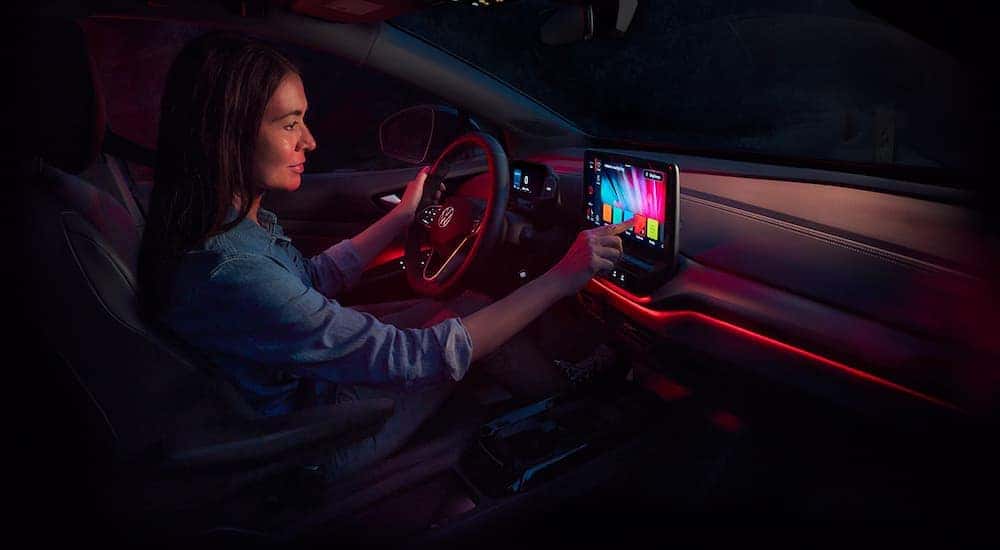
While the ID. 4’s all-electric setup is its most compelling feature, the SUV’s interior is a close second. Packed with more advanced features than the average space shuttle, this smart interior should resonate with today’s tech-savvy drivers. From customizable lighting and a smarter-than-average digital assistant to a unique steering wheel-based display and some design Easter eggs, there’s a lot of surprises in store on the all-new ID.4Electric Vehicle.
A Fresh Take On Tech Brings Convenience
VW has taken nothing for granted in the design of the ID.4 Electric Vehicle, reimagining the very concept of an interior and providing a fresh take on some features that we didn’t even realize were in need of an overhaul. Massive digital displays are nothing new, but all too often, size is emphasized over actual usability. Not so with the ID.4 Electric Vehicle, where a customizable home screen allows drivers to rearrange icons and video and data feeds in a move cribbed from today’s smartphones. The standard 10-inch Discover Pro screen can be upgraded to a 12-inch Discover Pro Max display, but it’s the ID. 4’s unique wheel-based interface that sets the SUV apart. As vehicles become packed with more and more screens, they elevate the risk of distracted driving. The steering wheel-mounted screen aims to address that possible risk, with this unobtrusive 5.3-inch screen displaying all relevant driving info right at the driver’s fingertips.
Also making its debut on the ID.4 Electric Vehicle and ID.3, VW’s innovative Hello ID voice recognition system sets a new bar for in-vehicle digital assistants. By relying on a more conversational voice command system, Hello ID injects some much-needed personality into the mix, providing an interface that feels more like talking with a trusty co-pilot than issuing commands to HAL 9000. Simply say “I’m feeling warm,” and Hello ID will automatically adjust the cabin temperature, while “It’s too dark” will open the panoramic roof and, because keeping morale up can be just as important as proper tire pressure on long road trips, “tell me a joke” sees the ID.4 Electric Vehicle do its best stand-up impression. Those who are sticklers for specificity can still issue more exact commands such as “set temperature to 73 degrees,” but the colloquial approach provides a relaxing change of pace for those approaching digital burnout.
A Friendly Interior Helps Set the Mood
Hello ID Light gives VW another chance to upend the typical driver-vehicle interface, with a color-coded strip of lights providing unobtrusive, nearly subliminal feedback for the driver. Located at the base of the windshield, this LED strip can serve as a GPS, battery indicator, communication tool, and emergency warning system. Hello ID Light kicks in as soon as you step start the vehicle, emitting a blue glow to let you know the incredibly quiet electric powertrain is actually on. An animated blue line provides turn-by-turn GPS directions while incoming phone calls appear as a light green pulsing. The Hello ID Light is useful even when you’re not actively driving, doubling as a battery charging indicator that can easily be spotted from a distance. This type of low-key feedback is also a boon to the ID. 4 Electric Vehicle’s safety credentials, providing a less distracting means of interaction that allows drivers to keep their attention on the road ahead.
The ID. 4’s other lighting trick is perhaps its best creature feature. Ambient cabin lighting is nothing new, but VW has elevated the game here, introducing customizable color palettes that will help set the mood for any drive. With 30 colors to choose from, drivers can select up to two colors at once to light three distinct areas of the cabin: the dash, doors, and center console. The combinations are nearly endless, giving drivers the chance to coordinate based on mood, time of day, or just to match their outfit. VW even includes some preset “moods” here, with color schemes that inject warmth, optimism, intensity, or calm into the cabin, giving you the ability to start off your day with a cheery bright yellow and make your way home in a moody red glow. In addition to the customizable lighting, that signature touch of VW whimsy can be found at the driver’s feet, where the gas and brake pedals have been emblazoned with the “play” and “pause” symbols.
Is MEB the Future of EVs?
Volkswagen’s commitment to EVs is beyond reproach at this point. With a stated goal of offering electric versions of all 300 vehicles across the 12 VW Group brands by 2030, few are as all-in on EVs as the German auto manufacturer. An ambitious goal for sure, but one that VW has made radically easier with the introduction of its MEB electric vehicle platform. Short for modular electric-drive toolkit (in German, of course – “Modularer E-Antriebs Baukasten”), the MEB aims to make EVs a more practical and affordable option for drivers and auto manufacturers alike. While EVs have come into their own in recent years, their design and construction are too often based on their gas-burning forebearers. This introduces inherent inefficiencies into the design, requiring manufacturers to optimize each model to fit the unique requirements of an EV drivetrain.
The MEB platform, on the other hand, has been designed from the ground up to provide the ideal base on which to build an EV. With an emphasis on aerodynamic design, a wider wheelbase, and improved weight ratio, this modular approach provides VW with a tried-and-true platform that not only saves on development costs and improves handling but also allows the brand to quickly integrate new technological developments across all models. The ID.4 Electric Vehicle, for example, is built on the MEB platform and features rear-wheel drive – an important distinction as front-wheel drive EVs often experience torque steer due to the instantaneous power of their electric motors.
As its use grows across VW Group’s brands, the MEB system holds the potential to transform the industry as a whole. The platform is already used on five VW Group brands around the world, proving itself in a range of vehicles from compact cars to SUVs and vans, but that’s just the beginning. In a bid to meet the ambitious goals of the Paris Climate Accord, VW will share the love when it comes to the MEB, allowing other manufacturers to build their own next-generation EVs on the platform. The brand already has one taker, with the German company e.GO Mobile set to introduce an MEB-powered vehicle in the near future.
Electric Cars are Here to Stay
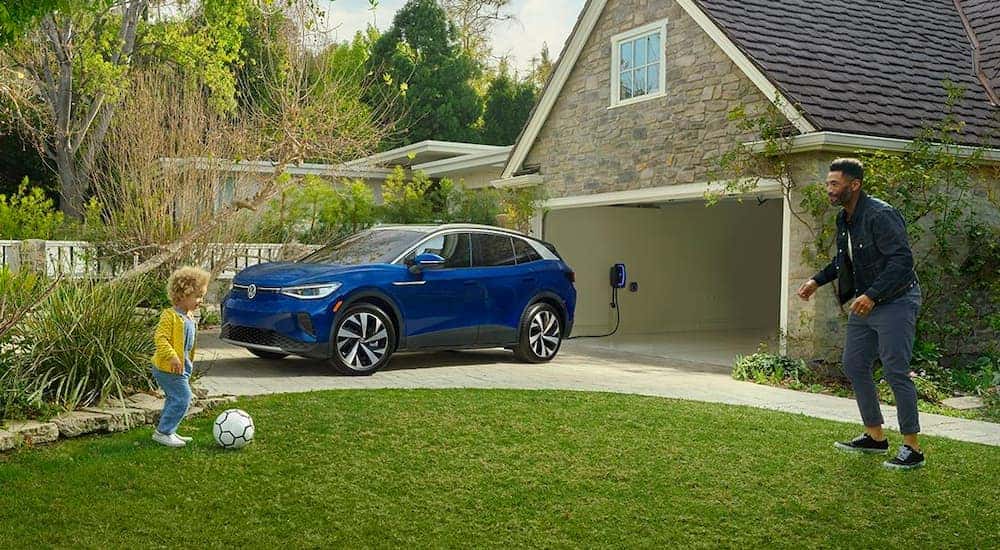
As EVs continue to move into the mainstream, they’re becoming increasingly stiff competition for their combustion engine brethren. This was especially evident at the 2021 World Car Awards, where the new ID.4 Electric Vehicle took home Car of the Year honors. No asterisk here; the ID.4 Electric Vehicle not only bested the newest EV offerings, but the sector as a whole, proving that VW’s new EVs are done playing second fiddle to traditional gas and diesel vehicles. With a range of between 240 and 260 miles and three years of free charging at Electrify America public charging stations, the ID.4 Electric Vehicle offers unmatched practicality – and fun – for drivers looking to save a few bucks while doing their part for the environment.
0 comment(s) so far on Volkswagen Puts Its Unique Spin On EVs With The ID.4 Electric Vehicle