



Another Ace in the Hole – Celebrating 8 Generations of the Volkswagen GTI

The automotive industry was suffering through heavy doldrums in 1974 when an exceptional idea was mischievously conceived by Volkswagen Chief Press Officer Anton Konrad and five co-conspirators. Prodded along by Board Member for Technology Hermann Hablitzel, the idea gestated in secret until its existence was revealed to, and approved by, the Chairman of the Board of Management Toni Schmücker in March of 1975. The catch? The new car had to debut at the International Motor Show in September of that year. It was a spirit of fun, determination, and ambition that parented the Mk1 (Mark 1) GTI, and that spirit lives on to this day! That’s why we’re so excited, as your Seattle VW GTI dealer, to welcome the all-new Mk8 GTI to our lot!
The legacy of the GTI is strong—the model has been sold uninterrupted for 45 years (and counting). While each car needs to be evaluated on its own merits, enthusiasts like us find value in that legacy, and there’s no time like the release of a brand-new generation to reflect on how so many things have changed—but not everything.
Mk1 GTI (1976 – 1983)
The one that started it all wasn’t much to look at. The square grille and bulbous, folded paper styling of the Golf were efficient, economical, and entirely unchanged for the Mk1 GTI. The changes that were made, however, went down in history. Black were the wheel arch extensions and rear window frame. Red, the edge lining of the radiator grille. The steering wheel was sporting, the seats were plaid (tartan, to be specific), and the shifter knob was a golf ball plopped on by Chief Designer Herbert Schäfer. The brakes were a little bigger, the suspension a little stiffer, and the engine was an Audi 80 GTE transplant.
The outcome was a car that even today is described as “impossibly endearing…alive and reactive” thanks to its cramped quarters, quick responses, and the feedback delivered by its unassisted steering and mechanism-dependent touchpoints. Electronically assisted features were not the wheelhouse of the economically-sensible Golf, after all. The barren interior is typical of its era, but the fact that it could outrun entry-level Porsches completely flipped the hierarchy of the sports car world. Despite this, the suspension changes kept things under control for the unexpected sports car, providing a confident ride that never feels unpredictable or edgy to modern drivers, which is a good thing for an old car lacking safety features and selling for similar prices to the brand-new Mk8!
The popularity of the Mk1 in its day cannot be understated. In an era where the Mustang had become forgettable and nothing had any power or fun factor to speak of, the Mk1 GTI was planned for a short 5,000-unit homologation run to allow VW to race it. Instead, it sold 490,000 cars. The greatest shame is that the US only got a Mk1 GTI in 1982 with a weaker engine, but the GTI spirit carried over otherwise. The Pennsylvania-built Mk1 GTI, built in America’s first manufacturing plant for a foreign brand, set the stage for years to come!
Mk2 GTI (1984 – 1990)
The Mk2 Golf GTI didn’t change too much—in terms of looks, performance, and spirit, it was very similar to its predecessor, and why shouldn’t it be? Changes in the market meant VW had to make it bigger, and power steering became a feature that the Golf needed to stay competitive, but otherwise, the Mk2 was just an updated Mk1. The red grille highlight and plaid seats became icons of the design in this generation, and four round headlights distinguished the GTI from the usual pair of lamps on the Golf. Big bumpers arrived near the end of the generation’s run, which changed the look a bit, and by 1991 it even got an automatic transmission. This GTI-first doesn’t get the blood pumping like a manual car, but it made the GTI more accessible to drivers who wanted to experience its dynamic handling without worrying about a third pedal.
Mk3 GTI (1991 – 1997)
The 1990s represent something of a dark age for the GTI. The era’s styling was softer and smoother than the 1980s had presented, and rapidly changing standards in safety and comfort led to a design that might be considered a misfire in GTI history. The former quadruple headlamps fused into single jelly beans at the corners of the grille, and the red grille stripe seems to have been a rare accessory feature. As a heavier car, it compares poorly against the Mk2, but it’s also more comfortable for daily driving. As a car designed and built in the era of transition from analog to digital, it retains much of the intimacy and mechanical feeling of those older cars in a way that modern versions simply don’t, which is a plus for enthusiasts. And even today, it remains affordable to those with the nerve to buy a 30-year-old hatch!
Mk4 GTI (1998 – 2003)
What a mixed bag we have here. Collectively, the Mk4 GTI was brilliant—the design expanded upon the concept of the Mk3 with bolder proportions and a more upmarket feel in general, positioning itself closer to Audi than Ford. It arguably represents a transition to a cleaner era of vehicle design, which was readily enhanced by simple body kits or sporty wheels! Yet, as a GTI, it’s long been regarded as a lost generation. One of the only visual cues to its heritage is the golf ball shifter knob—the rest of it, while higher in quality than the Mk3, was simply ordinary. It was also in this generation that a wide range of engines was offered in the GTI at various points, often as special editions, and the weakest of these were truly ordinary for the era as well. But the better ones had enough oomph that, if you wanted to use all of it, forced you to be the driver, to understand the road and your limits, so lost generation or not, the GTI spirit managed to live on.
Mk5 GTI (2004 – 2008)
Cue the angels singing from on high. The Mk5 was a total redesign of the Golf GTI, bringing back everything that was so great about Mk1 and Mk2 in a modern package. This is a design icon as well, though perhaps more polarizing than the Mk4 with a deep V-shaped grille and those signature wheels. Often called Denvers or Detroits (it depends on the size!), they had round holes and still managed to stand out! Plaid seats restored credibility further, but the real win was in performance. With a direct-shift gearbox (DSG) dual-clutch transmission option available for the first time, gear shifting was faster than ever.
In a DSG, there are two clutches, one for the even gears and one for the odd. Because the two clutches can work at the same time, like using two hands to wash dishes instead of just one, the operation is a lot faster and a lot more fun to drive than single-clutch designs. That’s not all—the suspension and chassis were significantly revised, including a multi-link rear suspension to replace the Mk4 solid rear axle for improved handling characteristics. The Mk5 GTI is a truly different vehicle from the Mk4 in every way, rewarding drivers who push it to the limit by delivering the excellent performance and value package that’s synonymous with the GTI name today.
Mk6 GTI (2009 – 2012)
More of a major facelift than a total redesign, the Mk6 nonetheless sports some distinguishing features to make it stand out from its predecessor. An emphasis on sound design led to the tailpipes being split to opposite sides of the rear bumper. The design started to feel modern, and a convertible GTI was offered for the first time (albeit only on European roadways) to capitalize on style points. The major highlight, though, was the direction of Hans-Joachim Stück, a successful German racer with a 32-year career that included two 24 Hours of Le Mans wins, three 24 Hours of Nürburgring wins, and 29 F1 World Championship points. His influence led to an improved power-to-weight ratio (which makes the car significantly quicker) and the inclusion of the XDS electronic differential locking system.
What does XDS do for you? During fast cornering, the inside wheels tend to lift up and lose traction, which leads to understeer for front-wheel drive cars––otherwise known as driving into the ditch across the road, because the car didn’t turn as much as it would have if all wheels had traction. XDS detects slippage from the lifting tire and applies brake pressure to act as a limited-slip differential, stopping the wheel from slipping on the asphalt and improving the car’s cornering ability. In essence, it improves stability and control at high speeds around corners, furthering the GTI mission of maximizing fun per dollar.
Mk7 GTI (2013 – 2021)
2012 was a significant year for Volkswagen Group because of the introduction of the MQB vehicle platform. This isn’t a true platform in the classic sense but rather a coordination of the components and features that underpin every vehicle to maximize the flexibility of the manufacturing system. An acronym that translates from German to mean “Modular Transverse Matrix,” MQB was designed to reduce weight and enable any factory that used it to assemble any vehicle, from super-mini to midsize crossover, built on the platform. Mk7 GTI drivers benefit from the first GTI ever to be lighter than its predecessor, giving it quicker acceleration, shorter stopping distances, and nimbler handling as a result of the benefits of MQB.
The Mk7 generation was also the first to feature two versions at the launch date, with the top-tier GTI Performance model being the first GTI with a differential lock for the front axle. This essentially sends more power to the wheel with traction if one of them is slipping—another key feature for combatting understeer. With an engineering team helmed by one Karsten Schebsdat, responsible for the Mk2 GTI and the Porsche 997 GT3 (the ultimate Porsche sports car not named Carrera from 2006 – 2011), the Mk7 earned its eight-year run, the longest of any GTI, through its achievement of everything great about the GTI name. Adaptive dampers make the ride more comfortable or sportier, depending on what you want, and the looks and practicality of the Mk7 GTI are as good as they ever had been. Then there are the special editions.
We’re going to highlight two—the Clubsport S and the Rabbit Edition. While limited to only 400 units, the Clubsport S was the record holder on the legendary Nürburgring Nordschleife for FWD production cars with a 7:49.21 lap time! If track driving is a little bit over your speed (as it is for most of us), the Rabbit Edition might be more interesting. The legacy of the 2019 Rabbit Edition is profound, reaching back to 1983 when the US-only Rabbit GTI was our version of the Mk1 icon! In a nod to that legacy, the Rabbit Edition is no tricked-out hyper-GTI—it slots in between S and SE trims with no sunroof, plenty of advanced driver assists, and Clark plaid seats. As Car & Driver put it, “The [Rabbit] GTI is fast enough for you to have a ton of fun, but not so fast that it’ll get you in (much) trouble,” a sentiment that we think fun-loving drivers everywhere can get behind.

Mk8 GTI (2022 – Present)
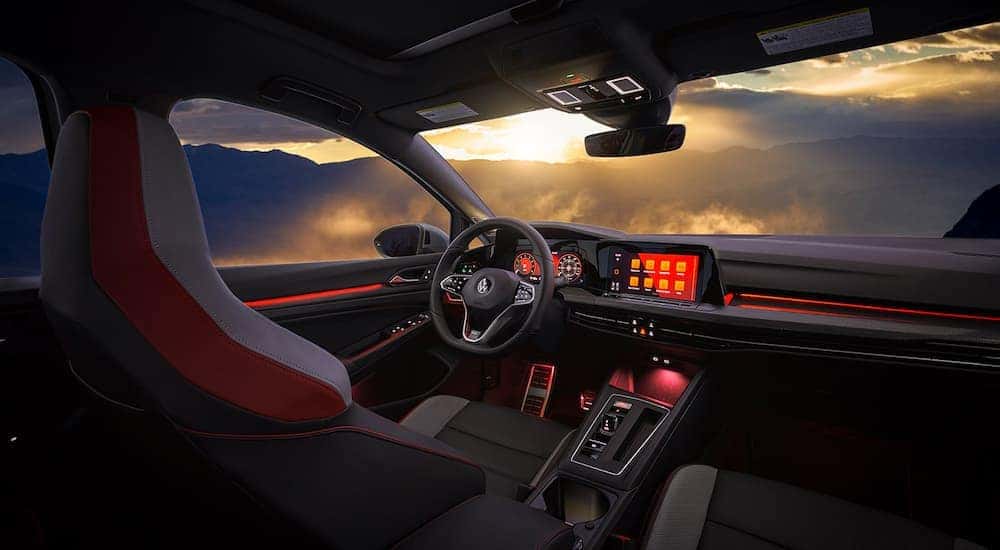
And finally, we arrive at the brand-new 2022 Mk8 Volkswagen GTI! The Mk7 is a tough act to follow, but the Mk8 engineers have stayed true to the spirit of making something new and defining the hot hatch genre rather than lose themselves in a desperate push for faster lap times. The chassis design and torque vectoring features introduced over the past couple of decades continue to deliver top-notch handling when the GTI is pushed. The exterior redesign, especially the broad grille and embedded X-pattern honeycomb fog lights, distinguishes it from prior generations. You’ll find a golf ball dimple pattern in the puddle lighting instead of on the shifter, but red highlights persist inside and out, and the cloth seats are, of course, available in plaid.
A lot has been made of the capacitive touch controls of the new GTI—the switch to interior controls that are almost entirely devoid of physical buttons can be alienating, but it certainly represents a commitment to driving design forward while staying true to the spirit of the past. The new GTI is once again lighter and quicker than the previous generation, in part thanks to a wide band of high torque output (meaning, it doesn’t take long before the engine is pushing hard, and it keeps pushing hard all the way to the redline). It also features a progressive variable-ratio steering system that becomes more responsive at high speeds and easier to use at low speeds for a better experience at all speeds! Sum up these and all the other amazing features of the GTI that we just don’t have time for here, and we think the Mk8 GTI is as true to its heritage as any other.
45 Years and Counting
The iconic VW Golf GTI is now in its 8th generation of blending high-quality German design with top-notch practicality and all the fun performance an everyday driver could ever want! We couldn’t be more excited, especially after taking this trip through history to remember everything and everyone that made this incredibly special car the legend that it is. With no compromises and an inextinguishable spirit of fun, the GTI might just be the best car ever.
0 comment(s) so far on Another Ace in the Hole – Celebrating 8 Generations of the Volkswagen GTI